
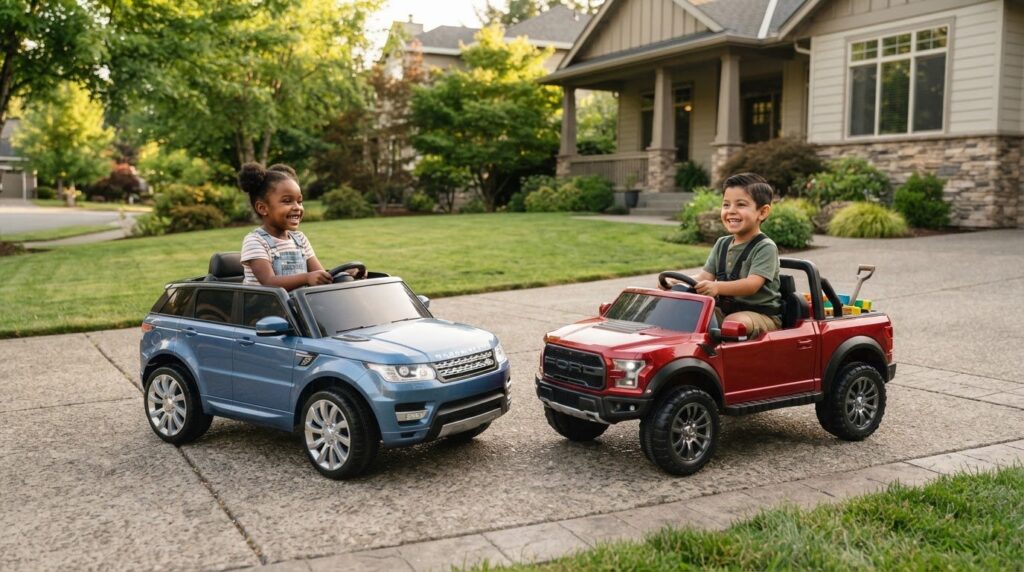
A pickup-truck look isn’t automatically better for bigger play. The ride on SUV vs ride on truck decision depends on how your child will use the vehicle: SUV styling often emphasizes an enclosed passenger cabin, while a truck’s cab-and-bed design gives it a utility-focused feel. Seat count, battery voltage, and the surface your child will drive on matter just as much as body style.
It’s easy to focus on looks, especially when both styles resemble miniature real vehicles. The better fit depends on whether you prioritize space for a passenger, a rugged truck design, or movement across your usual play area.
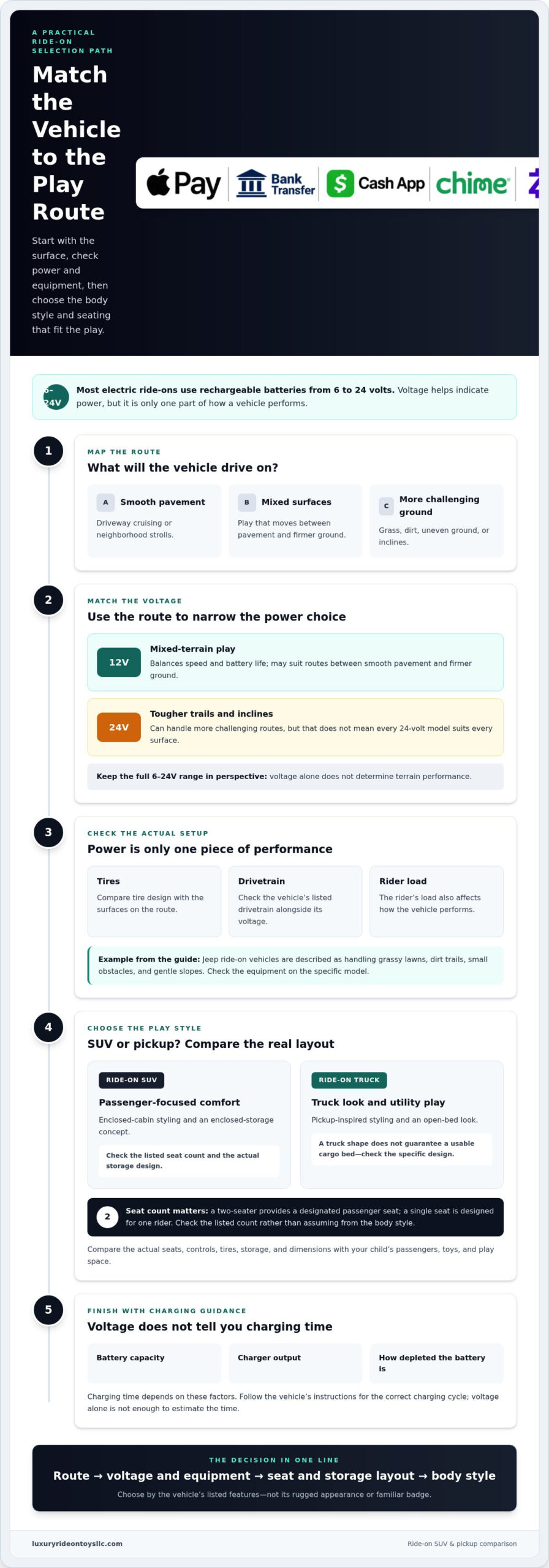
This guide compares seating and cargo space, battery voltage and terrain, and the practical differences between SUV and pickup-truck styles. Most electric ride-ons use rechargeable batteries from 6 to 24 volts; 12-volt models suit mixed-terrain play, while 24-volt models can handle tougher trails and inclines. Use those distinctions to narrow the choice to the vehicle that fits your child’s play.
Start with the seating layout, not the badge. A ride-on SUV may suit a child who wants an enclosed cabin, while a pickup-style ride-on brings truck-inspired utility to play. In full-size vehicles, an SUV combines passenger seating with enclosed cargo space; a pickup separates the passenger cab from an open bed. Those designs shape the look and storage concept, but ride-ons have their own seat counts and layouts.
Passenger space matters when siblings or friends will ride together. Some full-size SUVs seat up to eight people with a second-row bench, and some Chevrolet and GMC models seat up to nine with a front bench. Those figures describe full-size vehicles, not ride-ons. For a child’s vehicle, use the stated seat count: a two-seater gives a passenger a designated seat, while a single seat is designed for one rider.
Consider toys and other belongings, too. An SUV’s enclosed cargo area keeps items inside the vehicle’s body, while a truck’s open bed offers a distinct hauling-style space. On a ride-on, storage depends on the specific design, so don’t assume a truck-shaped model has a usable bed. Compare the actual seating and storage layout with what your child plans to bring.
| Option | Passenger seating | Cargo style | Best fit |
|---|---|---|---|
| Ride-on SUV | Check the listed seat count | Enclosed styling | Passenger-focused comfort |
| Ride-on truck | Check the listed seat count | Pickup-inspired styling | Truck look and utility play |
Match the listed seat count and usable storage to your child’s passengers and toys, then compare cabin comfort.
Charging time depends on battery capacity, charger output, and how depleted the battery is. Follow the vehicle’s charging instructions for the correct cycle; voltage alone doesn’t indicate how long charging takes.
Most electric ride-ons use rechargeable batteries ranging from 6 to 24 volts. Voltage helps indicate the vehicle’s power level, but terrain, tires, drivetrain, and the rider’s load also affect how it performs. Compare those details with the surfaces your child will actually drive on, such as a paved driveway or grassy lawn.
A 12-volt ride-on balances speed and battery life for mixed-terrain use. It may suit neighborhood strolls, driveway cruises, and play that moves between smooth pavement and firmer ground. For these routes, focus on a suitable surface and steady handling rather than choosing solely by the vehicle’s rugged appearance.
A 24-volt ride-on can handle tougher trails and inclines. That makes voltage worth considering for play involving uneven ground, but it doesn’t mean every 24-volt model is suited to every surface. Tire design and drivetrain matter too. Jeep ride-on vehicles are described as handling grassy lawns, dirt trails, small obstacles, and gentle slopes.
Separate styling from capability. A Silverado-inspired shape may look rugged, but the name or body style doesn’t tell you how a specific ride-on performs. Compare its voltage and listed equipment with your child’s route. An SUV may suit driveway cruising, while a more challenging course calls for closer attention to power and tires.
For a practical comparison, write down the usual surface, any slopes, and whether the route includes grass or dirt. Then match those conditions to the vehicle’s voltage and tire setup. A 24-volt truck-style option with rubber tires is one configuration to consider; explore 24V truck-style ride-on options alongside the terrain your child will use.
Charging time varies with battery capacity, charger output, and how much charge remains. Use the vehicle’s instructions to determine the charging cycle; voltage alone isn’t enough to estimate the time.
Choose a ride-on body style for the play it supports, not its real-vehicle reputation. A truck’s open-bed design suggests hauling, while an SUV suggests passenger-focused versatility. For a child’s vehicle, compare the actual seat count, controls, tires, and powertrain. Those details matter more than a miniature grille or familiar badge.
Full-size vehicle roles help explain the styling. Pickup trucks are designed for hauling and towing, with open beds and strong frames for heavy loads. SUVs combine passenger space with interior amenities for family travel. A ride-on borrows the look, but its capacity depends on its actual construction and listed features.
Size comparisons also show why real-vehicle assumptions don’t transfer directly. A full-size truck can be 10 inches or more longer than the biggest full-size SUVs. Full-size SUVs can measure 17 to 18 feet long. Those measurements describe adult vehicles, not ride-ons, so use the specific toy’s dimensions and available space when planning storage or maneuvering.
Construction also affects full-size vehicles. Body-on-frame designs can offer greater hauling and towing capacity and off-road capability. Unibody construction can support better fuel economy and driving dynamics. These are full-size design traits, not promises about miniature vehicles. For a ride-on, consider the stated voltage, tire type, seat layout, and intended surface together.
A child who mainly cruises a driveway, for example, may prefer an SUV’s passenger-car feel. A child drawn to pickup styling may enjoy a truck design. Match the vehicle to the play setting, then use its actual specifications to make the final choice.
Both styles borrow familiar full-size vehicle cues, but their shapes suggest different kinds of play. Compare practical features, not appearance alone.
A ride-on SUV has an enclosed, passenger-vehicle shape, often with a roof, doors, and a cabin-like seating area. Its styling may appeal to children who enjoy family-car role play or a streamlined exterior. Body style doesn’t determine seat count, storage capacity, or controls. Compare each model’s listed layout and features before deciding.
A pickup-truck ride-on copies the cab-and-bed silhouette for a utility-focused look. The miniature bed may be decorative, so don’t assume it carries toys. Check the vehicle’s design and specifications. Choose this style for a child drawn to truck details, not for adult-truck hauling capacity.
For toddlers, use the manufacturer’s stated age and weight limits to judge fit; body style alone can’t determine suitability. Seat belts and parental remote controls are model-specific features, not standard SUV or truck equipment. Compare the stated restraints and remote-control details, then match them to the child’s size and how an adult will supervise play.
Assembly depends on the model’s components and instructions, not whether it resembles an SUV or pickup. Routine care also follows the vehicle’s guidance, including attention to its battery and tires. Compare each model’s written warranty coverage and replacement-parts support. U.S. prices vary with factors such as voltage, seating, and included features, so compare complete specifications rather than style alone.
Compare kids’ SUV and truck ride-ons by their stated features to find a style that fits your child’s play.
Luxury Ride On Toys LLC offers the 2027 Licensed 24V Lamborghini Huracan 4×4 Complete Edition 2 Seater Kids Ride-On Cars With RC for families comparing passenger space and sporty styling. Its two-seat layout gives a child room to share the ride, while the 24V specification aligns with buyers considering higher-voltage options.
For a pickup-inspired alternative, the 2027 Licensed Ford F450 Custom Edition 24V Kids Ride-On Car Truck Rubber Tires, Leather Seat with Parental Remote combines truck styling with the listed tire, seat, and remote features. The 12V Kids 4WD Electric UTV with Dual Seats & Remote Control offers another dual-seat format. Compare these configurations against your preferred style and seating needs.
Visit Luxury Ride On Toys LLC to explore these ride-on options.
Before choosing, picture how your child will use the vehicle: solo driveway cruising, shared rides, or truck-themed play. That real-life scenario gives the ride-on SUV versus ride-on truck decision a practical test beyond color and styling. Keep your shortlist focused on features your family will use.
Luxury Ride On Toys offers distinct configurations to compare: the 2027 Licensed 24V Lamborghini Huracan 4×4 Complete Edition 2 Seater Kids Ride-On Cars With RC, the 12V Kids 4WD Electric UTV with Dual Seats & Remote Control, and the 2027 Licensed Ford F450 Custom Edition 24V Kids Ride-On Car Truck Rubber Tires, Leather Seat with Parental Remote. Use each model’s stated details to narrow your choice.
Take the next step at Luxury Ride On Toys and explore the options that fit your child’s style of play. A well-matched ride makes the next adventure feel personal from the start.
The main difference is body style and play theme: an SUV has an enclosed, passenger-car shape, while a pickup-style ride-on mimics a cab and bed. SUV styling may suit pretend family trips; a pickup shape fits pretend hauling. Neither outline proves actual storage or performance, so use each model’s listed features to decide.
Ride-ons can travel on pavement, while grass and gravel demand more traction and drive power. A smooth paved path differs from loose gravel or a soft lawn, where tires may lose grip or progress may slow. Match the vehicle’s drivetrain, tire design, and ground clearance to the route, and choose a play area clear of obstacles.
Choose a model whose manufacturer-stated age and weight limits fit the toddler. Seat belts and parental remote controls are model-specific, so compare those features, too.