
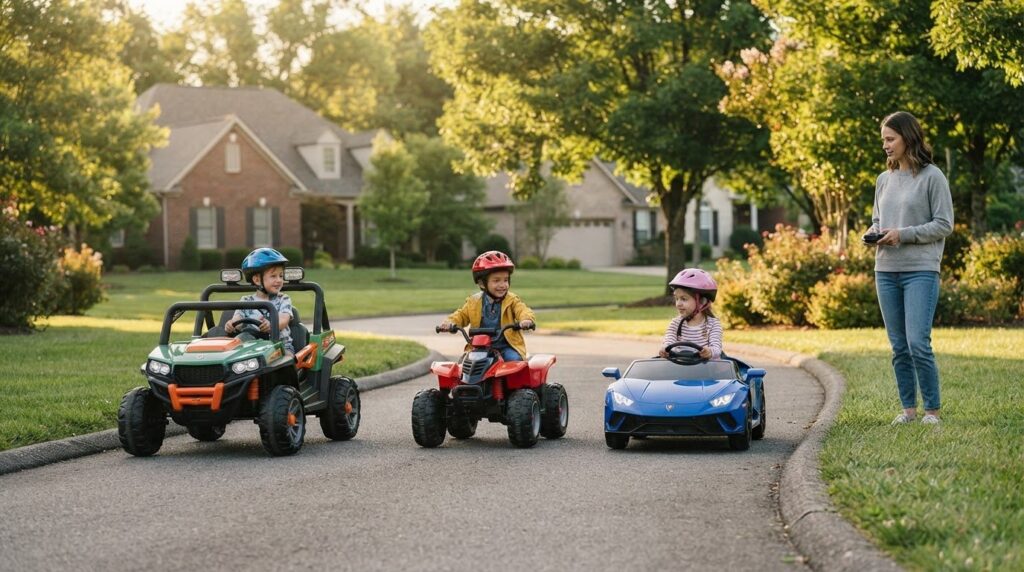
A 24-volt ride-on isn’t automatically the right fit for every child. Children’s battery-powered vehicles commonly use rechargeable batteries from 6 to 24 volts, with 12V and 24V among the typical choices. Choose a kids electric UTV, ATV, four-wheeler, car, or truck by matching its size and controls to your child, then consider where they’ll ride and how much adult supervision you want.
Power and rugged looks matter, but parent controls and practical safety features deserve equal attention. A remote can help an adult guide the ride, while seating, speed settings, and construction affect how well a vehicle suits a young driver. This comparison covers the differences between UTVs, ATVs, four-wheelers, ride-on cars, trucks, and off-road models, including what to consider in parental remotes and safety features. Choosing a kids electric UTV means weighing these details against your child’s experience, riding space, and plans for play.
Children’s electric ride-ons commonly use 6- to 24-volt batteries, with 12V and 24V systems typical. Compare vehicle shape, seating, and controls before choosing by voltage alone.
A kids electric UTV is a compact, side-by-side-style ride-on, often with a wider body and space for more than one child. Compared with a single-rider four-wheeler, its seating can make shared play easier. Consider whether the controls and dimensions suit your child and riding area. Voltage alone doesn’t determine riding time.
Ride-on ATVs and four-wheelers use a single-rider layout, usually with handlebars instead of a steering wheel. That separates them from side-by-side-style UTVs. Battery-powered children’s vehicles commonly use 12V or 24V batteries. Compare a kids electric UTV and a four-wheeler by rider position, seating, and controls, then consider the child’s experience and riding surface. Battery capacity, terrain, rider load, and driving style affect run time.
| Option | Typical layout | Battery choice | Comparison point |
|---|---|---|---|
| Ride-on UTV | Side-by-side style | 12V or 24V | Seating and controls |
| Ride-on ATV | Single rider, handlebars | 12V or 24V | Riding position |
Compare seating and controls first, then consider voltage and intended use.
Children’s electric ride-on UTVs aren’t automatically legal for public-road use in the United States. A toy’s design alone doesn’t establish road approval, and trail access depends on the rules for that trail and jurisdiction. Treat these vehicles as off-road toys, and ride only where access is allowed. Choose a suitable area and supervise the ride throughout.
Ride-on UTV costs vary with voltage, seating, drive configuration, and included controls. Online retailers and toy stores offer different models, so compare features and written terms before purchasing. Warranty coverage and return policies vary by retailer and model. Review the coverage, exclusions, return window, and shipping responsibilities in the purchase terms. Battery capacity, terrain, and driving style also affect how long each charge lasts.
Battery-powered ride-ons range from compact cars to trucks, SUVs, and utility-style vehicles. Compare the child’s fit, intended play, and 12V or 24V system before focusing on styling. A kids electric UTV is one option, but the right vehicle depends on the features that suit your family’s plans.
Ride-on cars, trucks, and SUVs have familiar vehicle shapes, but their size and layout suit different kinds of play. Cars favor a low, sporty profile, while trucks and SUVs often have a larger body and off-road look. Ride-on tractors and construction vehicles bring pretend-work themes, such as hauling or digging.
A 12V ride-on is one common battery-powered choice for children. It can power car, truck, SUV, and off-road styles, so voltage alone won’t tell you which body or controls fit best. Match the vehicle to the child’s experience and riding space. For a beginner, a top speed of 7 MPH may be too fast, especially for a three- or four-year-old just starting out.
A 24V system is another common option, used across ride-on cars, trucks, and off-road designs. Compare the complete vehicle rather than assuming voltage guarantees a particular speed or run time. Battery capacity, terrain, rider load, and driving style affect use between charges. The Dune Racer Extreme Ride-On Vehicle is a named model to assess by its listed features, fit, and intended riding surface.
A kids electric UTV has a utility-style design, distinct from a car’s road-focused shape and a tractor’s work-play theme. Compare models by seating, controls, body size, weight capacity, and battery system, and consider how each suits your child. The right choice is the one that fits your child and planned riding area, not simply the one with the boldest styling.
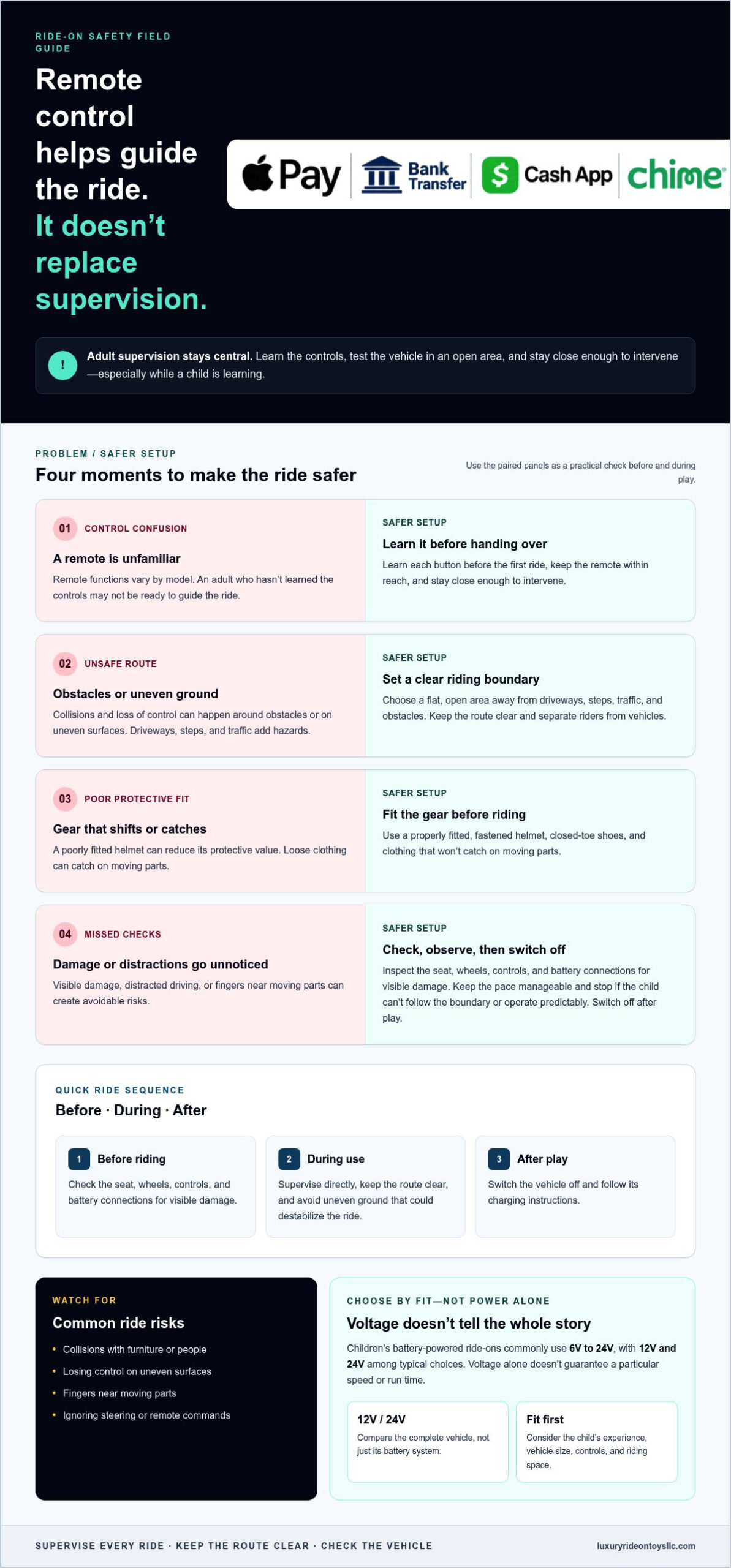
A parent remote gives an adult a way to guide a child’s ride, but it doesn’t replace supervision. Before the first ride, learn the controls, test the vehicle in an open area, and stay close enough to intervene. A kids electric UTV with a remote can help an adult guide a beginning driver as the child learns to use the onboard controls.
Remote functions vary by model. Learn each button before handing over the vehicle, and keep the remote within reach during every ride. Set a clear boundary, such as a flat, open area away from driveways, steps, traffic, and obstacles. Stop play if the child can’t follow the boundary or operate the vehicle predictably.
Children should wear a properly fitted helmet, closed-toe shoes, and clothing that won’t catch on moving parts. A helmet should sit securely and stay fastened; loose straps or a poor fit can reduce its protective value. An adult should supervise directly, especially while a child is learning to steer, brake, or respond to the remote.
Common risks include collisions with furniture or people, losing control on uneven surfaces, and fingers getting near moving parts. A child may also become distracted and ignore steering or remote commands. Keep the ride at a manageable pace, give one instruction at a time, and pause play if attention slips. These checks complement the vehicle’s safety features, but don’t make unsupervised riding appropriate.
The right kids electric UTV fits the child, riding area, and adult supervision plan. Start with the manufacturer’s recommended age range, then compare seat fit, vehicle dimensions, battery voltage, drive layout, and parent controls. A higher battery voltage alone doesn’t make a model the right match.
Age guidance varies by model. Kids’ UTV listings commonly include recommended ranges of 3-6 years and 3-8 years, so use the individual model’s guidance rather than assuming one range fits every child. Check that the child can sit comfortably, reach the controls, and understand how to stop before choosing a larger or more powerful ride-on.
| Decision factor | What to compare | Why it matters |
|---|---|---|
| Age fit | Model’s stated range | Matches the vehicle to the child’s stage |
| Ride space | Vehicle dimensions | Fits the available route and storage area |
| Battery | 12V or 24V | Helps distinguish power configurations |
| Controls | Child operation and parent remote | Supports supervised learning |
Use the table as a shortlist, not a ranking. A compact 12V model may suit a smaller, controlled play area, while a 24V option may better match a family seeking a different power setup. Compare the complete specifications, including seating, drive layout, and the conditions the manufacturer describes for use.
Choose the model whose age guidance, dimensions, and controls match your child and route. Compare kids’ ride-on vehicle options by layout and features before deciding.
Luxury Ride On Toys LLC is a practical next step after narrowing your choice by seating, battery, and parent control. The 2027 Licensed 24V Lamborghini Huracan 4×4 Complete Edition is a two-seat ride-on car with remote control, bringing a distinctive licensed design to families comparing shared-seat options. For a kids electric UTV style layout, the 12V Kids 4WD Electric UTV has dual seats and remote control. The 2027 Licensed Ford F450 Custom Edition 24V Kids Ride-On Car Truck adds rubber tires, a leather seat, and parental remote. Compare each model’s layout and features against your child’s needs and planned riding space. Visit Luxury Ride On Toys LLC to explore the ride-on options.
Before choosing a kids electric UTV, picture an ordinary afternoon: where your child will ride, where the vehicle will be stored, and how an adult will supervise. A clear plan makes the purchase more practical and gives your child consistent boundaries from the first ride, rather than leaving the rules to be worked out later.
Let your child’s interests guide the final choice, while you make the decision based on fit, control, and how the vehicle will be used at home. A favorite design can make the ride feel special; a setup that suits your family makes it easier to enjoy together. If you’re ready to compare suitable options, contact Luxury Ride On Toys. Take the next step with a clear idea of what will work for your child and your space.
Speed and age suitability vary by model, so use its stated guidance rather than choosing by appearance. Kids’ UTV listings include recommended ages of 3-6 years and 3-8 years. A top speed of 7 MPH may be too fast for a three- or four-year-old who’s just starting out. Consider the child’s driving experience and ability to follow directions before selecting a model.
Battery capacity and riding conditions are more useful clues than voltage alone when comparing run time. Check the battery’s amp-hour rating, then consider how rider load, terrain, speed, and stop-start driving affect use between charges. Higher voltage doesn’t automatically mean longer rides. Choose a route that lets an adult end the ride before the battery runs low.
Children’s electric ride-ons commonly use 12V or 24V batteries, within a typical overall range of 6 to 24 volts. A 48V model sits outside that commonly used range, so compare its specific operating guidance carefully. For a kids electric UTV, weigh the child’s experience, vehicle controls, and riding surface alongside voltage. Battery capacity and driving conditions also influence how long a charge lasts.
Look for parent remote control, child-accessible controls, stable seating, and a clear way to stop the vehicle. Before each ride, inspect the tires, seat, steering, and visible wiring for damage, then choose an open route away from traffic and obstacles. A properly fitted helmet and closed-toe shoes add practical protection. Keep an adult close enough to supervise and intervene.
Kids’ electric UTVs are available from online retailers and toy stores. Warranty coverage and return policies vary by retailer and model, so review the written terms, including exclusions, return window, and shipping responsibilities.
After play, switch off the vehicle and follow its charging instructions. Before riding, check the battery connections for visible damage.