


The biggest ride-on isn’t automatically the best fit. For families who want shared rides, a four wheel drive ride on car with two seats may be the better choice; electric ride-on vehicles typically use rechargeable batteries ranging from 6 to 24 volts. The right option depends on who will ride, where the vehicle will be used, and which features matter most to your family.
Compare more than appearance when choosing a four-wheel-drive ride-on car. Seating, drivetrain, battery, and overall value all matter. A two-seater can work well for siblings or shared family rides, while a single-seat model may be a better fit for one young driver.
This guide compares four-wheel-drive and off-road-style ride-ons, explains how to weigh prices and discounts, and helps you decide whether a two-seater suits your child and family. Use the same practical criteria across models instead of judging by one specification alone.
The best choice matches the child, riding surface, and level of adult control. Electric ride-on vehicles typically use rechargeable batteries ranging from 6 to 24 volts, so compare the power setup alongside remote controls and safety features. These cars can be used more safely when an adult supervises and the vehicle’s controls and restraints suit the child.
A parental remote lets an adult guide the ride while a young driver is still learning the controls. Check the listed functions, such as steering, forward and reverse movement, speed selection, and stopping. Remote features vary by model, so compare the actual controls rather than assuming every remote works the same way.
Picture the child starting, turning, and approaching a stopping point. Can an adult use the remote to take control at each step? Consider where the adult will stand and whether the controls are easy to operate. A clear layout can make supervision more manageable during a short driveway ride.
Safety depends on the vehicle’s features and how the ride is supervised. Check for a seat restraint, manageable speed settings, stable rubber tires, and a parent-operated stop function. Match the seat and controls to the child’s size and ability. Even a four-wheel-drive ride-on car needs a suitable riding area and an attentive adult.
Before each ride, secure the restraint, inspect the tires, and test the parental remote in an open area. Keep the route clear of steps, traffic, and obstacles, and stay close enough to intervene. Read the vehicle’s age, weight, and operating guidance, then make sure it suits the intended rider. A remote helps with supervision but does not replace adult attention.
Drive labels help narrow the field, but battery voltage and intended surface matter too. In the United States, off-road ride-on toys are described as 12 V vehicles, while kids’ ride-on UTVs are described as 4×4.
A four-wheel-drive or all-wheel-drive label suggests that power reaches multiple wheels, but the label alone does not explain how a particular model works. Compare its listed drivetrain, motor setup, tires, and intended riding surface to find a configuration that suits your family.
Look for practical details in the product description: does it say 4×4, identify driven wheels, or describe traction features? Don’t assume all-wheel drive and four-wheel drive mean identical hardware across ride-on models. A clear specification helps you compare vehicles without relying on a rugged body shape alone.
Off-road styling can include raised-looking bodies, broad tires, and Jeep-style details, but appearance doesn’t establish capability. A 12 V battery is a stated configuration for off-road ride-on toys; compare that figure with the listed drive system and the surfaces where your child will ride.
Licensed designs may resemble familiar vehicles such as the Chevrolet Silverado, while Jeep-style bodies have a different look. Treat the licensed badge as a styling feature and focus on the operating specifications. Review the battery, seating, tire material, and controls together to assess how the vehicle fits your child’s needs.
For a focused comparison, browse 4×4 ride-on vehicle options and assess the listed drivetrain against your intended riding surface.
Ride-on car prices reflect more than the body style. Compare the drive system, battery configuration, seating, tire material, remote controls, and included features across similar models. A four-wheel-drive off-road vehicle and a licensed sports-car design serve different priorities, so a direct comparison works best when the core specifications match. The Mercedes G63 look, for example, describes styling, not the vehicle’s complete equipment or performance.
For an off-road-style model, begin with the drivetrain and intended use. Then compare tire material, seat layout, and parental controls. These features matter more to practical use than a rugged exterior alone. Apply the same checklist to Jeep-style vehicles, Chevrolet Silverado-inspired trucks, and compact sport models instead of judging value by appearance.
Compare discounts on a like-for-like basis. Identify the exact model and its listed regular and sale prices, then weigh the stated saving against the features in that listing. A promotion on a two-seater is not directly comparable with one on a single-seat vehicle, and a lower price may reflect a different configuration. Focus on the full specification and final listed price, not the discount headline.
Before choosing, list the features that matter: drive type, battery, seats, tires, remote functions, and included equipment. Compare listings intended for similar uses, such as family rides or off-road-style play. Then weigh each vehicle’s listed price against your priorities. A Mercedes badge, Silverado styling, or another licensed design may add visual appeal, but the specifications show what the purchase includes.
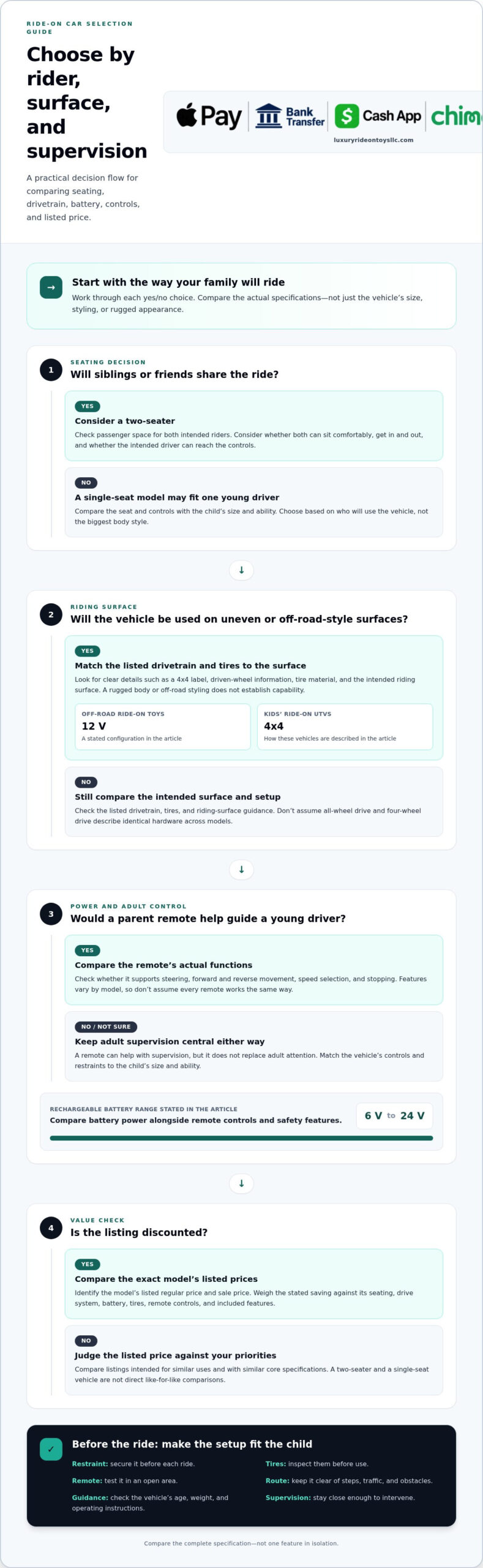
A two-seater can suit siblings or friends who will share a ride. Check the available seating space for both intended riders and consider whether they can sit comfortably and reach the controls. A two-seat, four-wheel-drive ride-on car combines shared seating with a four-wheel-drive format, but seating alone does not determine whether it is right for your family.
Start with how your family plans to use the vehicle. For shared driveway rides, consider how both children will get in and out, where they will sit, and whether the controls suit the intended driver. For uneven terrain, compare the listed drivetrain and tires with the surface. Electric power and two seats do not make every model equally suitable for every rider or route. For another useful comparison of body styles and play needs, see this guide to ride on SUV vs ride on truck.
Compare the exact specification rather than relying on the words “two-seater.” The 2027 Licensed 24V Lamborghini Huracan 4×4 Complete Edition 2 Seater Kids Ride-On Cars With RC identifies both a 4×4 setup and two seats in its name. The 12V Kids 4WD Electric UTV with Dual Seats & Remote Control gives another example of a four-wheel-drive model with shared seating. Those descriptions make a useful starting point for comparing format and controls.
Choose a two-seater if regular shared rides matter more than a compact, single-rider layout. If one child will usually drive, compare single-seat options too; an extra seat is useful only if your family will use it. Check the model’s controls and supervision features before choosing an electric vehicle.
Compare two-seater ride-on options by seating, drivetrain, and remote controls to find a configuration that fits your family.
Luxury Ride On Toys LLC offers the 2027 Licensed 24V Lamborghini Huracan 4×4 Complete Edition 2 Seater Kids Ride-On Cars With RC for families comparing shared seating, four-wheel drive, and remote control. Its listed name brings those key decision points together, making it a relevant option when two children may ride and an adult wants remote-control capability.
For a different body style, the 12V Kids 4WD Electric UTV with Dual Seats & Remote Control also combines four-wheel drive, dual seating, and remote operation. The 2027 Licensed Ford F450 Custom Edition adds rubber tires, a leather seat, and parental remote; the 027 Licensed 24V Lamborghini Revuelto lists rubber tires, a leather seat, and RC. Compare each model’s stated features with your family’s priorities.
Visit Luxury Ride On Toys LLC to explore these ride-on options.
Decide what matters most to your family: shared seating, four-wheel drive, or a parent-operated remote. Use that priority to narrow your options, then compare the vehicle’s details with the child’s size, riding space, and expected use. A four-wheel-drive ride-on car can be a good fit when its layout and controls suit the rider, not just because it looks rugged.
Luxury Ride On Toys LLC offers options that reflect different priorities, including the 2027 Licensed 24V Lamborghini Huracan 4×4 Complete Edition 2 Seater Kids Ride-On Cars With RC, the 12V Kids 4WD Electric UTV with Dual Seats & Remote Control, and the 2027 Licensed Ford F450 Custom Edition 24V Kids Ride-On Car Truck Rubber Tires, Leather Seat with Parental Remote. Compare their listed features with your family’s needs.
Contact Luxury Ride On Toys LLC to explore the options and take the next step toward a ride your family can enjoy.
It is an electric children’s vehicle designed to send power to all four wheels. The drivetrain describes how the vehicle is powered, not how it will perform on every surface. Compare the stated drive system with the tires, seating, and controls. For example, a four-wheel-drive UTV and a four-wheel-drive sport car can have different layouts and intended uses.
The best 4WD ride-on in 2026 is the model that fits the child, riding area, and family’s priorities. Start with the rider’s size and ability, then compare seat layout, drive details, tires, and parent controls. A shared family ride may call for dual seating, while one young driver may prefer a single seat. Judge the full setup, not just the vehicle’s styling or 4×4 label.
The price of a four-wheel-drive ride-on car depends on its features and configuration. Seating, battery setup, tire material, remote controls, and licensed styling all affect how listings compare. To assess value, compare vehicles with similar seating and equipment, and read the full product details alongside the listed price. A discount is meaningful when you know which model and features it applies to.
Age and weight limits are set for each ride-on model, so there isn’t one universal limit for every 4WD vehicle. Match the stated age guidance and maximum load to the child who will ride. Also consider whether the child can sit securely, reach the controls, and use the vehicle’s layout comfortably. For a two-seater, account for the combined riders’ weight against the vehicle’s stated capacity.
Battery runtime and charging time depend on the vehicle’s battery and how it’s used. Electric ride-ons commonly use rechargeable batteries ranging from 6 to 24 volts. Longer or more demanding rides, rider load, and frequent starts can affect how quickly power is used. Follow the model’s charging instructions, use its supplied charging equipment, and recharge after use to prepare it for the next ride.
The listed electric kids’ ATV has a maximum speed of 3.5 miles per hour, while the ATV for toddlers is listed at 1.2 miles per hour.